What it is
Critical infrastructure location data is often incomplete and unevenly distributed globally, especially in developing regions. Earth observation foundation models are proposed as a way to understand the built environment more efficiently, yet they remain largely untested on the facility-scale assets that underpin a range of societal and economic functions.
Infra-Bench CLS tests them on 18,756 Sentinel-1 SAR and Sentinel-2 multispectral images of facility-scale assets at 10 m resolution, covering seven continents, with asset locations drawn from 10 OpenStreetMap classes.
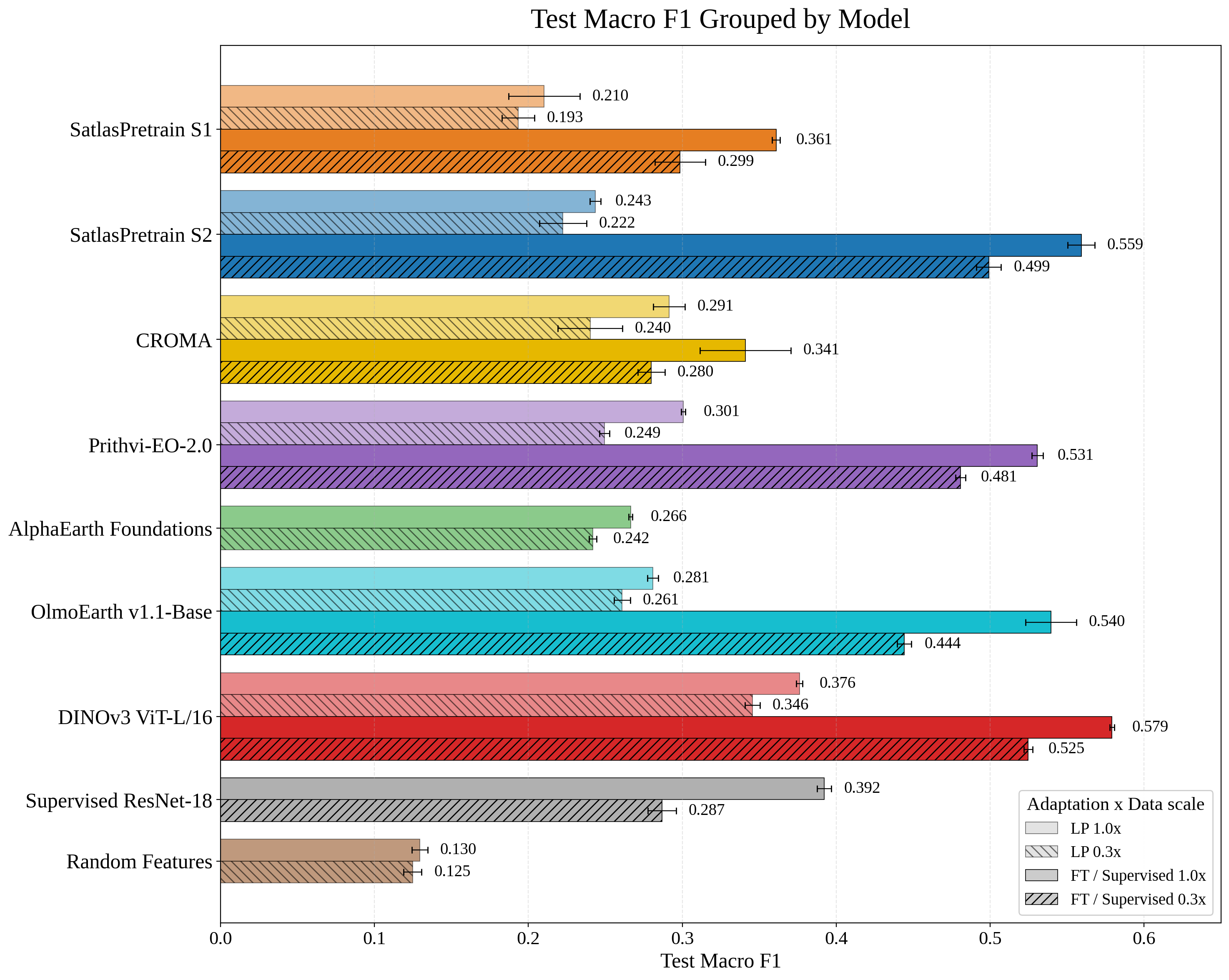
Seven foundation models are evaluated with linear probing and fine-tuning, at two training set sizes (1.0× and 0.3×) and three seeds each, against a supervised ResNet-18 and a random features floor. That gives thirty conditions, all on one fixed spatial split, so training and test assets never share a spatial block.
What we found
Fine-tuning matters more than the choice of backbone. Four of the six fine-tuned foundation models beat the supervised ResNet-18 baseline of 39.2% macro F1, and none of the frozen linear probes did. The best was DINOv3 ViT-L/16 fine-tuned on the full training set at 57.9%, a 48% relative improvement over the baseline.
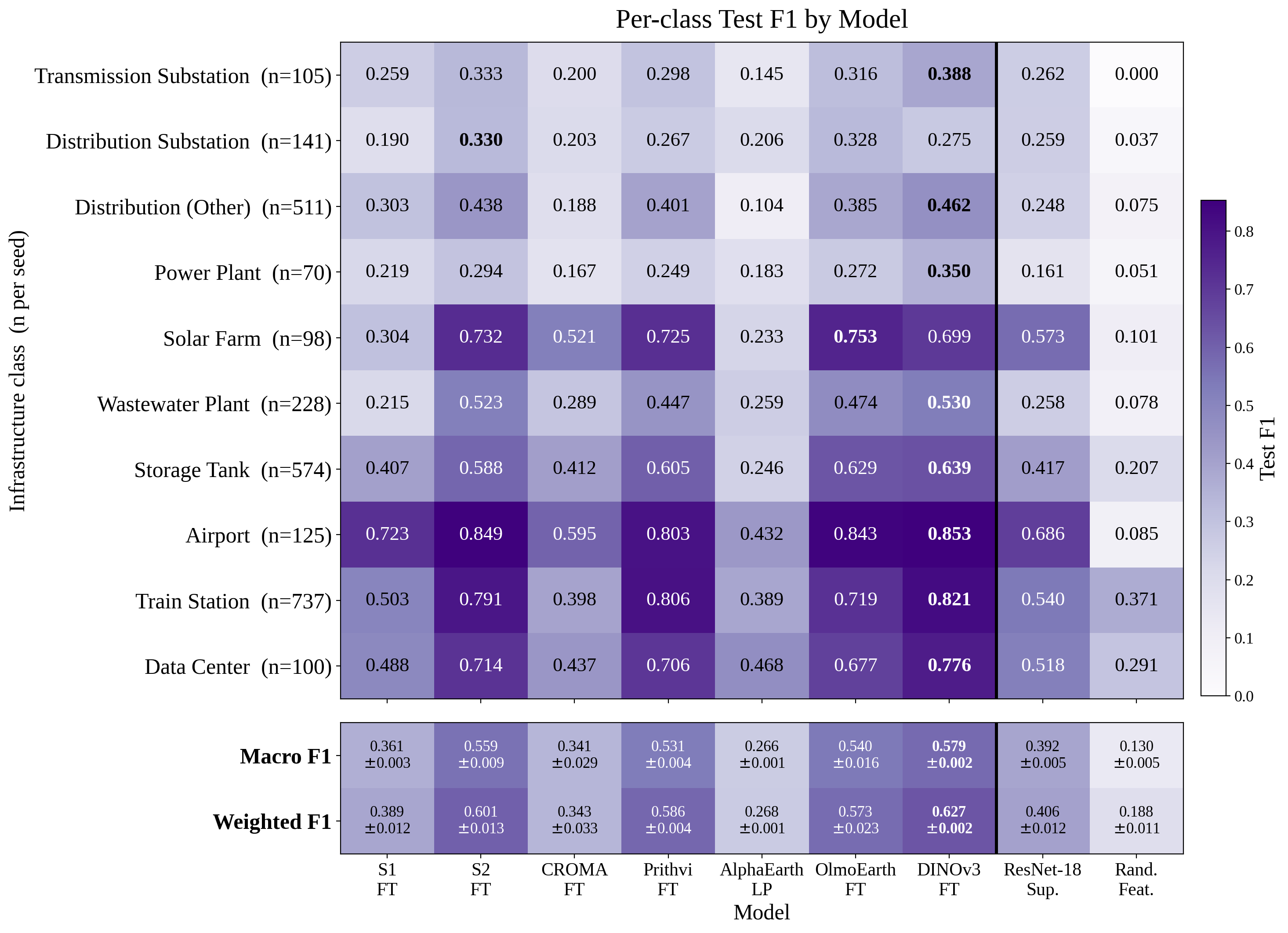
Results vary widely by class. Airports (85.3%), train stations (82.1%), and data centers (77.6%) score well, while many power sector classes stay difficult, ranging from 27.5% to 46.2%.
Paper, data, and code
- Paper
- arXiv:2609.09482. The benchmark, the evaluation protocol, and the full results.
- Dataset
- 10.5281/zenodo.22118892. The curated tile dataset, archived on Zenodo.
- Code
- justing0909/infra-bench-cls, archived at 10.5281/zenodo.22256967. Curation pipeline, evaluation notebooks, and figure scripts.
Cite
Please cite the paper. If you use the tiles or the code, cite those alongside it.
Paper
@misc{guthrie2026infrabenchcls,
  title         = {Infra-Bench CLS: A Global, Open-Source Benchmark for
                   Critical Infrastructure Classification with Earth
                   Observation Foundation Models},
  author        = {Guthrie, Justin and Oughton, Edward and Wessels, Konrad
                   and Rice, Matthew and Corley, Isaac},
  year          = {2026},
  eprint        = {2609.09482},
  archivePrefix = {arXiv},
  primaryClass  = {cs.CV},
  url           = {https://arxiv.org/abs/2609.09482}
}
Dataset
@dataset{guthrie2026infrabenchclsdata,
  title     = {Infra-Bench CLS: A Global Multimodal Satellite Imagery Dataset
               for Critical Infrastructure Classification},
  author    = {Guthrie, Justin and Oughton, Edward and Wessels, Konrad
               and Rice, Matthew and Corley, Isaac},
  year      = {2026},
  publisher = {Zenodo},
  doi       = {10.5281/zenodo.22118892},
  url       = {https://doi.org/10.5281/zenodo.22118892}
}
Code
@software{guthrie2026infrabenchclscode,
  title     = {Infra-Bench Classification (Infra-Bench CLS) GitHub Repository},
  author    = {Guthrie, Justin},
  year      = {2026},
  version   = {1},
  publisher = {Zenodo},
  doi       = {10.5281/zenodo.22256967},
  url       = {https://doi.org/10.5281/zenodo.22256967}
}